

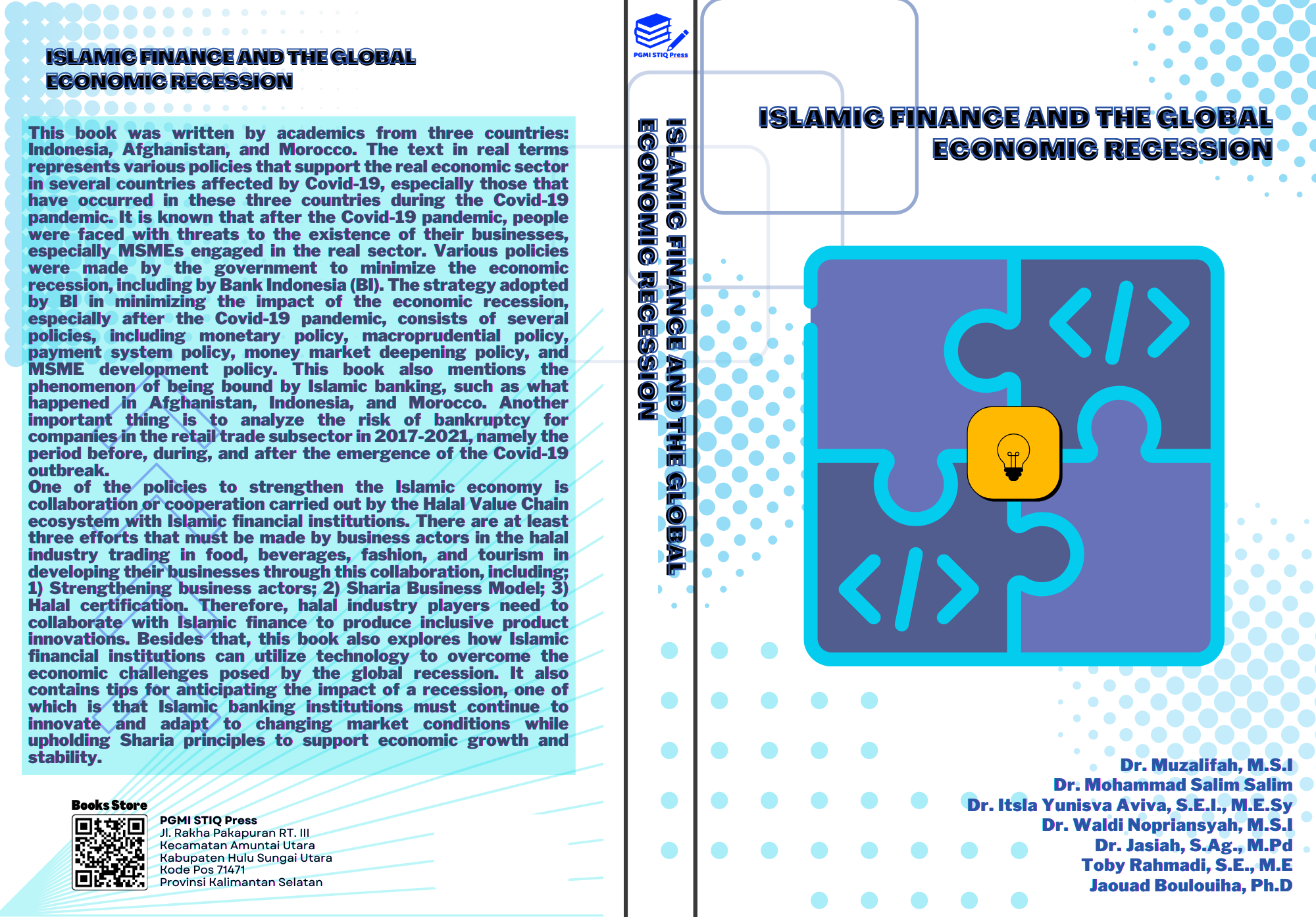
Islamic Finance and The Global Economic Recession
Rp85.000
Deskripsi Produk
Judul: Islamic Finance and The Global Economic Recession
Penulis : Dr. Muzalifah, M.S.I; Dr. Mohammad Salim Salim; Dr. Itsla Yunisva Aviva, S.E.I., M.E.Sy; Dr. Waldi Nopriansyah, M.S.I; Dr. Jasiah, S.Ag., M.Pd; Toby Rahmadi, S.E., M.E; JaouadBoulouiha, Ph.D
ISBN : 978-623-8279-05-0
Editor: Dr. Andi Holilullah; Dr. Hj. Musyarapah, M.Pd.I
Layout & Desain Sampul : Tim PGMI STIQ Press
Halaman : viii ; 164
Ukuran Buku: 15,5 x 23 cm
Diterbitkan oleh: PGMI STIQ Press
Berat: 190 gr
Available on backorder
Sinopsis:
This book was written by academics from three countries: Indonesia, Afghanistan, and Morocco. The text in real terms represents various policies that support the real economic sector in several countries affected by Covid-19, especially those that have occurred in these three countries during the Covid-19 pandemic. It is known that after the Covid-19 pandemic, people were faced with threats to the existence of their businesses, especially MSMEs engaged in the real sector. Various policies were made by the government to minimize the economic recession, including by Bank Indonesia (BI). The strategy adopted by BI in minimizing the impact of the economic recession, especially after the Covid-19 pandemic, consists of several policies, including monetary policy, macroprudential policy, payment system policy, money market deepening policy, and MSME development policy. This book also mentions the phenomenon of being bound by Islamic banking, such as what happened in Afghanistan, Indonesia, and Morocco. Another important thing is to analyze the risk of bankruptcy for companies in the retail trade subsector in 2017-2021, namely the period before, during, and after the emergence of the Covid-19 outbreak.
One of the policies to strengthen the Islamic economy is collaboration or cooperation carried out by the Halal Value Chain ecosystem with Islamic financial institutions. There are at least three efforts that must be made by business actors in the halal industry trading in food, beverages, fashion, and tourism in developing their businesses through this collaboration, including; 1) Strengthening business actors; 2) Sharia Business Model; 3) Halal certification. Therefore, halal industry players need to collaborate with Islamic finance to produce inclusive product innovations. Besides that, this book also explores how Islamic financial institutions can utilize technology to overcome the economic challenges posed by the global recession. It also contains tips for anticipating the impact of a recession, one of which is that Islamic banking institutions must continue to innovate and adapt to changing market conditions while upholding Sharia principles to support economic growth and stability.
Additional information
| Weight | 190 kg |
|---|---|
| Dimensions | 15,5 × 2 × 23 cm |




Reviews
There are no reviews yet.